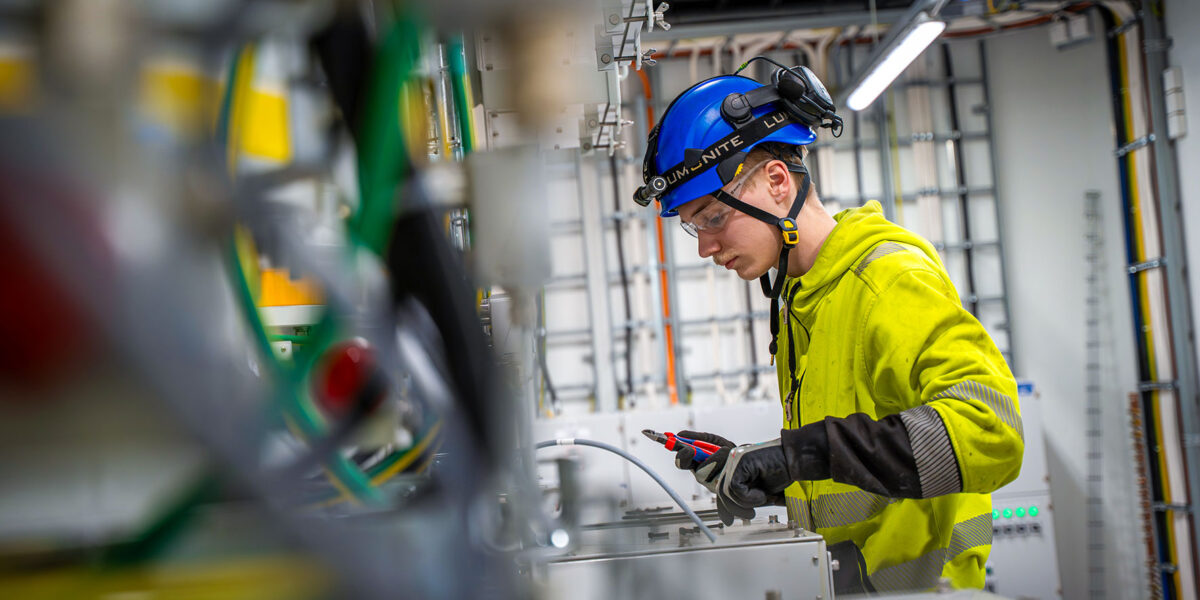
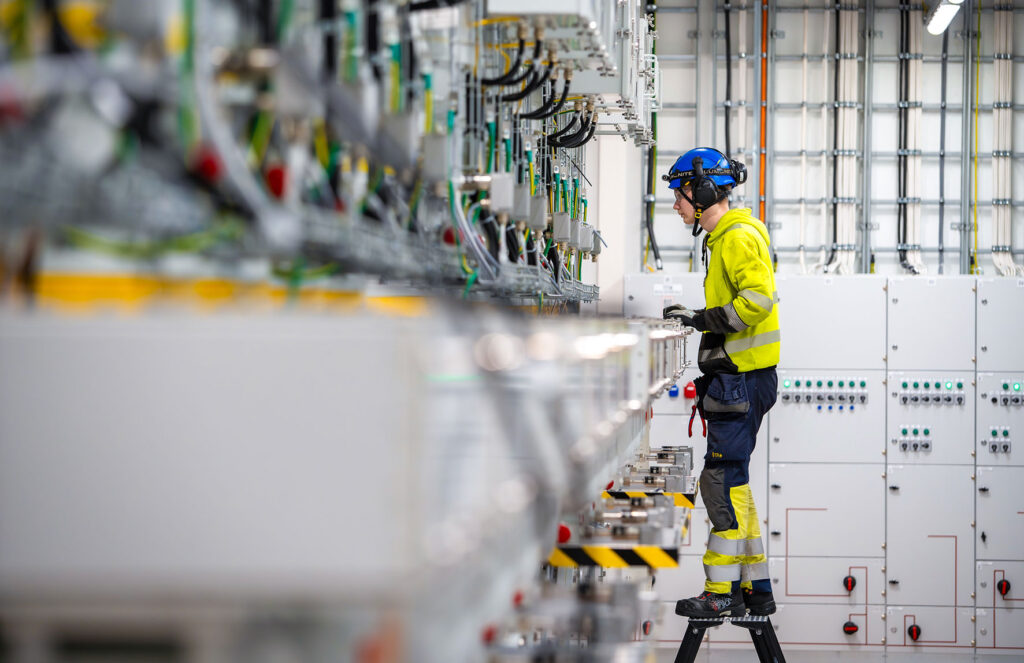
Fingrid’s Tihisenniemi substation in Kajaani is currently undergoing a major expansion while the station remains in full operation.
“The power is on, so we must be careful at all times. On the construction site, every cable must be treated as if it is energised, and attention must not be distracted for a moment,” says Site Manager Heikki Pietikäinen from VEO.
Substations cannot always be taken out of service completely during construction and extension work, and especially at key nodes in the electricity network, work has to be carried out in a live environment.
Therefore, the mechanical works on the Tihisenniemi substation extension will be carried out while the station is energised, and the actual outage will only take place in the spring before commissioning.
“Worksite safety is based on professionals understanding the risks. There is no room for assumptions in a live environment, and every step of the work is planned and checked in advance,” says Jari Heinonen, Project Manager from VEO.
Even just moving around an energised construction site requires special attention. Cables must never be stepped on, access routes are clearly defined in advance, and separate work surfaces are built in the cable cellars.
Daily safety toolbox talks to review the risks
Routines can turn into risks, which is why daily safety toolbox talks are held at the Tihisenniemi worksite. They review the specificities of the live station and ensure that the dangers are not forgotten.
“We need to talk about safe working practices every day,” Pietikäinen stresses.
The orientation for new employees includes a detailed safety briefing, and each employee signs to acknowledge they have understood the instructions.
The key risks at the Tihisenniemi worksite and ways to manage them have been compiled in a single folder, and each worker must be familiar with the contents of the folder before starting work.
“The most important thing is that the instructions are understood and not just acknowledged as read.”
There are several subcontractors working on the Tihisenniemi substation extension site, and they also need to understand the risks of a live site.
“It must be made clear to everyone that all cables are energised by default, unless proven otherwise,” Pietikäinen stresses.
Electric shocks increased at Fingrid sites
Although safety practices at the Tihisenniemi site are stricter than average and accidents have been avoided, the overall situation at Fingrid worksites is clearly worse: electric shocks have increased over the past year.
In 2025, there were 26 near misses or accidents related to electricity at Fingrid worksites, 11 of which were electric shocks, compared to only one in the previous year. Seven of last year’s electric shocks occurred during measurement work.
“Workers have not always taken into account where the protection of the installation is adequate and where it is not. The use of incorrect measuring heads and inadequate tools have also caused incidents,” says Jani Pelvo, person in charge of operation of electrical installations at Fingrid.
Last year, there were also four near misses related to additional earthing. According to Pelvo, one typical mistake is careless tightening of the current path connector of an auxiliary or additional earthing device.
“After each electric shock, the worker must be escorted to a health centre.”
The danger posed by low voltage should not be underestimated, Pelvo reminds.
“A low-voltage electric shock is dangerous to humans and can cause ventricular fibrillation if the current passes through the heart, for example from one hand to the other. After each electric shock, the worker must be escorted to a health centre.”
Better job planning and more precise work instructions
In 2026, Fingrid worksites will focus particularly on improving electrical safety, which is reflected in the content of training courses, for example.
According to Pelvo, construction sites need more detailed plans for the work phases. For more hazardous work, such as measurements in live installations, method-specific work instructions are required.
Plans and work instructions should be reviewed by the team just before the start of each individual work phase, and the hazards should be known in advance.
“It should not be up to the worker to decide how to manage risks or what tools to use. The work instructions must clearly state what protective equipment and tools are required for the job and, for example, what type of measuring wires are used in different situations.”
Pietikäinen also stresses the importance of site tidiness. It is easier to identify energised structures and high-risk areas in a tidy workplace than in a cluttered environment.
“Tools should not be left lying on top of instruments. Any extra rubbish or dropped tools increase the risk of electric shocks.”